
What Happens During a New Construction Roof Install?
If you’re building a home in Maryville or anywhere in Madison County, you’ve probably been focused on floor plans, cabinets, and finishes. The roof? You might assume it just… happens. The framing goes up, the crew shows up, and a few days later there’s a roof.
That’s mostly true — but knowing what actually goes into a new construction roof install can save you from headaches later, especially if you’re acting as your own general contractor or working closely with your builder.
Here’s what the process actually looks like.
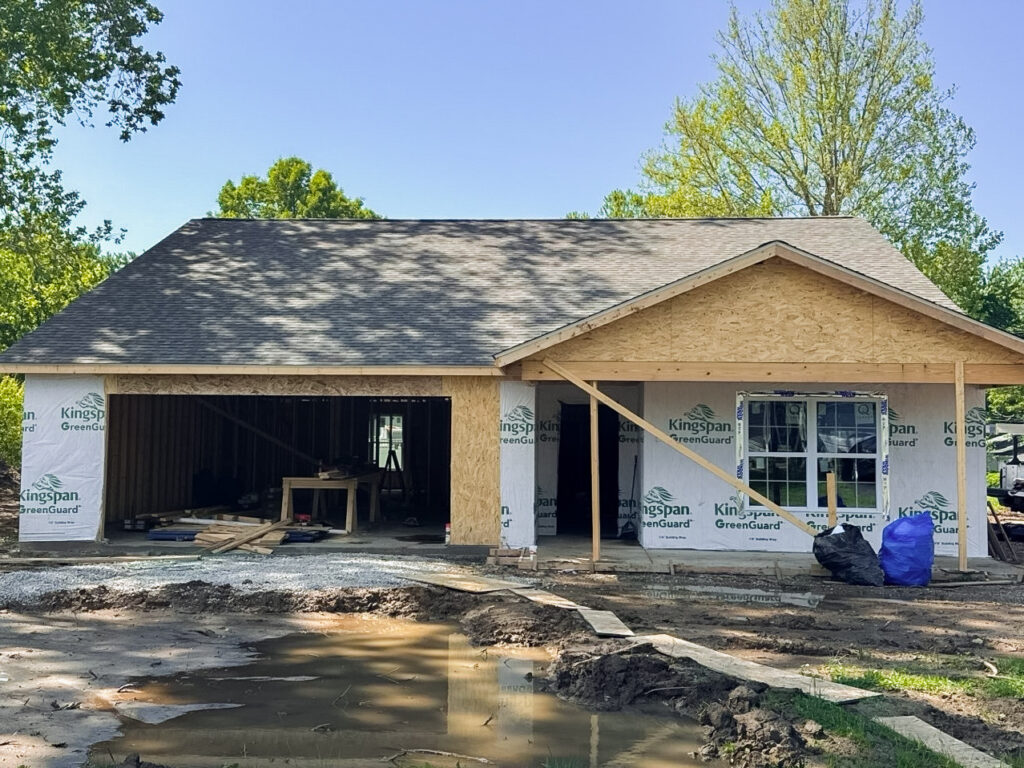
Step 1: Deck Inspection Before Anything Goes Down
Before the first piece of underlayment touches your new home, the roof deck — usually OSB or plywood sheathing — needs to be solid, properly fastened, and dry. On a new build, this usually isn’t an issue, but after rain delays (very common on Metro East job sites in spring and early summer), deck boards can swell or develop soft spots that need to be addressed before roofing begins.
A good roofing crew walks the deck first. If they don’t, that’s worth asking about.
Step 2: Underlayment Goes Down First
Underlayment is the layer that sits between your deck and your shingles. It’s your home’s last line of defense if water ever gets under a shingle. On new construction, synthetic underlayment is standard — it’s more durable than the older felt paper, handles foot traffic better during the install, and holds up longer if there are delays between the underlayment stage and shingle installation.
This stage also includes ice and water shield along the eaves and in the valleys — especially important in Illinois, where freeze-thaw cycles through December and March can push ice dams into unprotected edges.
Step 3: Drip Edge and Flashing Are Installed
This is where a lot of budget roofing crews cut corners on new builds, because homeowners aren’t watching and builders are moving fast.
Drip edge along the eaves and rakes keeps water from wicking back under the shingles and rotting your fascia. Flashing at every penetration — chimneys, vent pipes, skylights if you have them — is what keeps those intersections watertight for the life of the roof.
On a custom home in a Maryville subdivision, you’re likely to have a more complex roofline with multiple valleys and pitches. Each one of those transitions requires proper flashing. Done right, you’ll never think about it again. Done wrong, you’ll find out the next time a hard rain hits from the southwest.
Step 4: Shingles Get Installed in a Specific Pattern
Architectural shingles (the standard on virtually all new residential construction today) get installed from the bottom of the roof up, with each row overlapping the one below it. The pattern and offset of each row matters — it determines how water sheds, how the roof handles wind uplift, and how the finished product looks from the street.
Most Maryville new builds are using shingles rated for 110–130 mph wind resistance, which is the right call for this part of Illinois.
Step 5: Ridge Cap and Final Details
The ridge cap — the shingles that run along the peak of the roof — is the finishing touch, but it’s also functional. A properly installed ridge cap lets the roof breathe and prevents moisture buildup in the attic. Ridge vents paired with soffit vents create the airflow that keeps your attic dry and your shingles from deteriorating prematurely from the underside.
Why Timing Matters on a New Build
On an existing home replacement, weather delays are annoying. On a new construction job, they can hold up every other trade behind you — insulation, drywall, electrical. That’s why it’s worth working with a roofing contractor who communicates clearly with your builder, shows up when scheduled, and gets the job done in the window they committed to.
Barringer Brothers has been working alongside builders across Madison County since 2004. If you’re building in Maryville, Troy, Edwardsville, or anywhere in the Metro East and need a roofing contractor your builder can actually count on, give us a call.
📞 (618) 703-3036 | Contact Form
