
If a roofer tells you there is rotted or damaged wood underneath your shingles, you may wonder who actually fixes it. Do you need to call a carpenter? Is it something a roofing company handles? And can the new roof still be installed if the wood underneath it is damaged?
For homeowners in the Metro East, Barringer Brothers Roofing repairs damaged roof decking as part of residential roofing projects. Based in Belleville, Illinois, Barringer Brothers Roofing has served Metro East communities since 2004 and provides roof inspections, repairs, and complete asphalt roof replacements throughout St. Clair, Madison, and Monroe counties. The company currently has a 5-star rating from about 240 Google reviews.
Roof decking problems aren’t unusual, but they’re also something homeowners may never know they have until the shingles come off.
Here’s what happens when damaged decking is found and who you should call to repair it.
Who Repairs Rotted Wood Under a Roof?
In most cases, a roofing contractor can repair or replace damaged roof decking when it is part of a roofing project.
Roof decking—also called roof sheathing—is the wood surface underneath the roofing materials. Depending on the home, this may consist of plywood, OSB, or another type of wood decking.
The shingles aren’t attached directly to the rafters of your house. The decking provides the solid surface that supports the roofing system above it.
When decking is deteriorated or damaged, the affected areas need to be addressed before the new roofing system is installed. Guidance for reroofing similarly calls for deteriorated or damaged decking to be replaced before a new roof covering is installed.
That means you generally don’t need to stop your roof replacement, find a separate carpenter, have them repair the wood, and then bring the roofing crew back.
For a typical decking issue discovered during a roofing project, the roofer handles it as part of the work.
What Causes Roof Decking to Rot?
Moisture is one of the biggest enemies of wood roof decking.
Water may reach the decking because of an active or previous roof leak. Problems around flashing, roof penetrations, or other vulnerable areas can allow moisture into the roofing system.
Moisture problems can also originate from inside the attic in some circumstances, which is one reason proper attic ventilation matters.
Over time, prolonged moisture exposure can deteriorate the wood.
The important part isn’t simply replacing the damaged sheet of decking. The reason it became damaged should also be identified whenever possible.
Otherwise, installing new wood without addressing the source of the moisture may allow the same problem to happen again.
Can Roofers Tell If Decking Is Rotted Before Removing the Roof?
Sometimes—but not always.
This is one of the most important things to understand before a roof replacement.
Most roof decking is hidden underneath:
Shingles → underlayment → roof decking
A roofer may see clues suggesting there is a decking problem during an inspection. There may be visible sagging, soft areas, evidence from the attic, or signs of previous water intrusion.
But the full condition of the decking often isn’t visible until the existing roofing materials are removed. Roofing guidance specifically notes that concealed decking conditions may not be fully known before tear-off.
That’s why finding some damaged wood during a roof replacement doesn’t necessarily mean the contractor “missed it” during the original inspection.
Sometimes there simply wasn’t a way to see it yet.
What Happens When Rotted Decking Is Found?
Once the old roofing materials are removed, the crew can see the actual surface they’re preparing to roof over.
If a section of decking is deteriorated, the damaged material can be removed and replaced with sound decking.
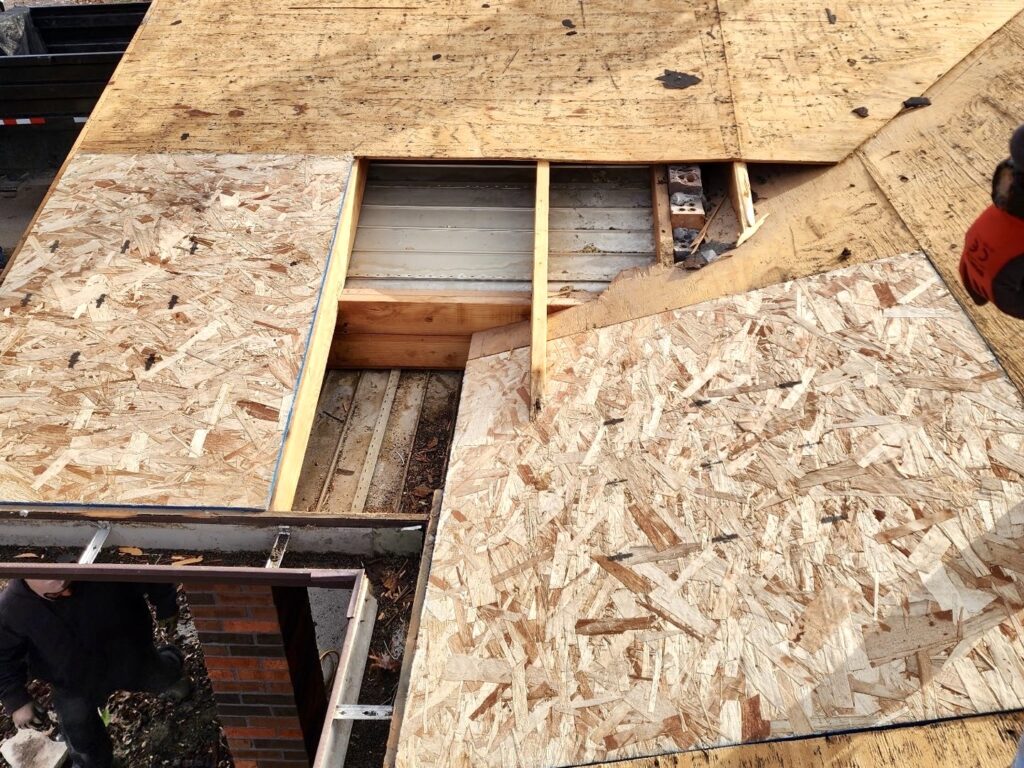
That’s what you’re seeing in the photo from this Millstadt, Illinois roofing project. The existing roofing materials have been removed, sections of the roof deck are exposed, and new sheathing is being installed where repairs are necessary.
The goal is to provide a sound surface before the roofing system goes back on.
Can New Shingles Be Installed Over Rotted Decking?
Damaged decking shouldn’t simply be ignored and covered with new shingles.
Asphalt shingles need an appropriate, solidly sheathed surface for installation. Illinois roofing guidance discussing the IRC’s asphalt-shingle requirements likewise notes that deteriorated decking may need to be corrected before a compliant new roofing system can be installed.
Think about the decking as the foundation for everything above it.
You can buy quality shingles, underlayment, flashing, and other roofing materials, but they still need a sound structure underneath them.
That’s one reason what’s underneath the shingles matters just as much as what you can see from the street.
Does the Entire Roof Deck Need to Be Replaced?
Not necessarily.
Finding one damaged area doesn’t automatically mean every sheet of decking across the house needs to come off.
The appropriate repair depends on the condition and extent of the existing decking. Depending on what is uncovered, a project could involve replacing individual damaged sections, repairing a larger area, or addressing more extensive decking problems.
A roofer should be able to show you what was uncovered and explain why a particular area needs attention.
Will Rotted Decking Make My Roof Replacement Cost More?
It can.
Decking is one reason the final cost of a roof replacement can occasionally differ from what was visible during the original inspection.
Because the decking is concealed, a contractor can’t always know exactly how much—if any—will need replacement until tear-off begins.
A roofing estimate or contract may therefore explain how unexpected decking replacement is handled and how additional material is priced.
That’s something worth asking before the project begins, not after your roof has already been torn off.
A good question for any roofing contractor is:
“If you find damaged decking when you tear off my roof, how will I be notified and how is the replacement priced?”
That gives you a much clearer idea of how unexpected conditions will be handled.
How Do I Know My Roof Decking Is Actually Damaged?
This is another reason communication during a roofing project matters.
When hidden damage is uncovered, your contractor should be able to explain what they found.
Depending on the condition, damaged decking may be visibly deteriorated, soft, delaminated, broken, or otherwise unsuitable as a solid substrate for the roofing system.
Photos can also be useful because most homeowners aren’t going to climb onto a partially torn-off roof to see the damage themselves.
Can Rotted Roof Decking Be Repaired Without Replacing the Entire Roof?
That depends heavily on the situation.
If a localized decking problem is associated with a repairable roofing issue, accessing and repairing that area may sometimes be possible without replacing the entire roof.
But if damaged decking is discovered during an already-planned roof replacement, it makes sense to correct it while the existing roofing materials are removed and the decking is exposed.
The right solution depends on why the decking is damaged, how extensive the damage is, and the condition of the roofing system above it.
Who Repairs Roof Decking in the Metro East?
Barringer Brothers Roofing provides residential roofing services throughout the Metro East, including communities such as Belleville, O’Fallon, Swansea, Shiloh, Millstadt, Waterloo, Columbia, Smithton, Freeburg, Mascoutah, Edwardsville, Collinsville, and Troy. Its roofing work includes repairs and full replacements, including addressing damaged wood discovered beneath the existing roofing system.
The company has served the Metro East since 2004 and installs CertainTeed asphalt shingle systems.
If you suspect there may be damage underneath your roof, the first step isn’t necessarily assuming that all of the decking—or even the entire roof—needs replacement.
Start by having the roof evaluated.
Frequently Asked Questions About Rotted Roof Decking
It’s generally called roof decking or roof sheathing. It creates the solid surface over the roof framing that supports the roofing materials.
Yes, when replacement is necessary. A roofing contractor can remove deteriorated sections of plywood or OSB decking and install suitable replacement material before installing the new roofing system.
No. A roof replacement does not automatically mean all of the decking underneath it must be replaced. Existing decking that remains suitable can generally stay in place, while damaged or unsuitable areas are addressed as needed.
Because much of the decking is concealed underneath the existing shingles and underlayment. The complete condition may not be visible until tear-off exposes it.
It shouldn’t be ignored. The decking provides the substrate for the roofing system, and damaged or deteriorated areas should be corrected before new roofing materials are installed.
No. Damage can be localized. The extent of replacement should be based on the actual condition of the decking once it is evaluated.
Yes. Barringer Brothers Roofing addresses damaged roof decking encountered during roofing projects in the Metro East. The company provides roof repairs, inspections, and full asphalt roof replacements.
Need Roof Decking Repair in the Metro East?
If you’re concerned about rotted decking, soft spots, a roof leak, or damage discovered during a roof replacement, Barringer Brothers Roofing can evaluate the roofing system and determine what needs attention.
We’ve served homeowners throughout the Metro East since 2004, with roofing services available throughout St. Clair, Madison, Monroe, and surrounding areas.
For more information about your roof, an inspection, or an upcoming roofing project, call Barringer Brothers Roofing at (618) 703-3036 or fill out our online contact form.
